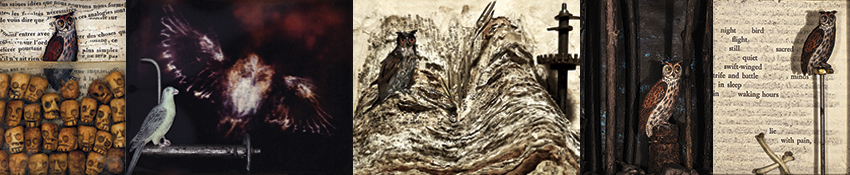
FLACO THE OWL
The saga of Flaco, the eagle-owl liberated from his tight enclosure at the Central Park Zoo into a world utterly alien to him, with no survival skills and untested instincts, captivated the city. He lived on his own in Central Park for nine months, before slowly venturing out to explore nearby buildings and neighborhoods.
In February 2024, after a year in the “wild,” Flaco collided with a window of an Upper West Side high-rise and died, his health, and perhaps his perceptual apparatus, compromised by rat poison and a bird virus that he’d ingested with his prey.
Artist Statement
From the moment I learned of his “escape” from the Central Park Zoo, I was captivated by the fortunes of Flaco the Eurasian Eagle Owl and took every opportunity I could find to put myself in his presence, which wasn’t especially difficult for quite a long time, as his preferred roost and hunting grounds were not very far from my apartment. Although I didn’t really analyze my fascination until much later, I suppose that his freedom represented a pure and simple paradigm of liberation, and I felt that I could somehow usefully project my solidarity and hope in his behalf while absorbing something of his own animal majesty in mine.
But the more I’ve pondered his brief and celebrated public career, the less inclined to romanticize his problematic taste of liberty I’ve become, much though I understand and empathize with the motives that led so many of his fellow New Yorkers and avid followers throughout the world to identify in him a symbol of their own relationship to the scarcely tenable ways of living that the cage of our social order has imposed upon us and the unextinguished ember of the instinct for freedom that still glows within us all in spite of that.
I began making art in homage to Flaco more or less from the inception of our relationship, often using the pellets he expectorated and their undigested contents as components of book-based assemblages: I suppose that the immemorial association of owls with wisdom subtly determined my choice of the book as the primary vehicle for the work. I had been, after all, an antiquarian bookseller for twenty years in Heidelberg before I was able to find my own way to freedom as a full-time artist in America, and far from resenting it as an instrument of my captivity, I always cherished the book, which I genuinely encountered only late in my adolescence, as the key to my release. And I suppose, too, that I felt a fraternal sympathy with this creature whose own eccentric course had so much in common, at least superficially, with my own: two Europeans transplanted into alien but endlessly fascinating New York, uncertain whether our untested dreams of flight could withstand its multifarious adversities or the longstanding desuetude of our own deepest impulses.
In invoking Hegel’s famous dictum – “the owl of Minerva takes flight only at dusk” – for the title of the present exhibition, I don’t so much wish to imply that we’re vouchsafed wisdom only too late as that the dissolution of the settled world demands that we reassess the wisdom we’d previously assumed. The owl of Minerva is dislodged from its slumber at dusk and sets out in search of new sustenance, in Flaco’s case, an entirely new way of being. And for us, his witnesses, the foreknowledge – always tempered by that minuscule possibility that he’d outpace the formidable odds against him – that his fate had been sealed, demands a reassessment of the simplistic tropes, often the abiding blandishments of art itself, that enable us to persist in spite of universal injustice, for Flaco had been wrenched from the world of his ancestors and kept thirteen years in mute captivity for our mere enjoyment, though but few of us ever even registered his existence; one might go so far as to say that although he was, in fact, created for our pleasure we scarcely took notice of him at all until he fortuitously entered the matrix of our innermost concerns.
And if art is to be something less dispiriting than the celebration (or an example in itself) of noble failure, and this when it’s functioning at its best, or a call into the night for a companion who pointedly is not there, for an existential integrity we know even as we embrace the fiction can never be real under, as Adorno said, a comprehensive regime of deceit, then it’s important to attune ourselves to the true lessons of the epic of Flaco, foremost among them that although our relationship to nature has been thoroughly perverted we remain part of it, and even if that does not constitute definitive hope, it is objective evidence of something other than the hopeless in which we are immersed.
|